Monday, 25 July 2016

Taking the coastal path


Ok, I admit it, the sea has claimed my mind once again, thanks to the glorious summer weather in Norfolk and a recent escape to the ever-inspiring coast of Pembrokeshire in Wales.

My Oak King and I embarked on a travelling holiday, staying in a different place each night and covering more ground than we would otherwise have done. Beginning on the English side of the border, with visits to Kenilworth Castle and the Neolithic and Bronze Age Rollright Stones, we moved on for a day at the literary Hay Festival in Hay-on-Wye, before continuing on towards the sea.

At Manorbier we explored the ancient castle, used as a backdrop in the 1980s/90s television adaptation of the Chronicles of Narnia.


At Stackpole, we struggled through the soft sand, paddled in the cool water, and found barnacles, limpets and rich red anemones, like boiled sweets, in the cliff crags and huge jellyfish washed up on the shore.


At Abereiddy we searched for didymograptus fossils and saw jellyfish swimming in the Blue Lagoon and a huge crab scuttle across the sea floor


Meanwhile at nearby Porthgain, after some rather delicious fish and chips at The Shed, we were lucky enough to spot a lone seal, basking on a raft tethered just outside the harbour.


Finally, at Trefin, we walked a little of the Pembrokeshire Coast Path on a baking hot day, where the sea sparkled, the skylarks sang, and the ruins of slate buildings clung to the cliffs.


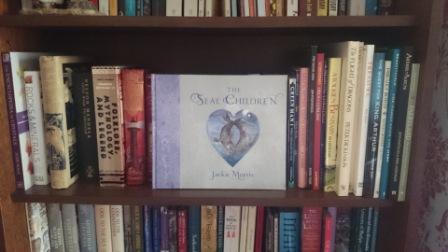
I also had the opportunity to visit the marvellous Solva Woollen Mill, and collected my signed copy of Jackie Morris's recently republished book, The Seal Children. Back at the B&B, I eagerly devoured both story and illustrations.


Lucky for me, waiting at home was another literary gem - The People of the Sea by David Thomson - and so I was able to indulge in many more tales of coastal life, selkies and mermaids. Thomson's book is hauntingly evocative, detailing the stories of his own journeys and experiences meeting locals in the Hebrides and on the west coast of Ireland. He captured many traditional folk tales, straight from the mouths of the elders, with their dialects preserved, which may otherwise have been lost.

Best wishes for a very happy summer, rich with adventures, for those reading from the Northern Hemisphere, or a magical winter for those in the south.

Photo of Manorbier: Paul Allison

Friday, 8 April 2016

Hidden messages from the past

Have you ever wondered what secrets your house may be hiding? Past events, stories of previous occupants - maybe even long-forgotten or deliberately concealed objects?

Hidden and apotropaic objects, such as witch bottles, shoes and dried or mummified cats, have always fascinated me on so many levels. Not only the objects themselves, but the moment or circumstances of their placement; the reasons for their placement; the people or person who placed them; and the feelings they evoke in the modern day.

Their incongruousness, their age, their mystery, their links with and potential to hold magic all inspire a curious sensation in the 21st century onlooker, which varies very much from individual to individual. The objects often inspire terror, vulnerability and a kind of violation - the householder having been completely unaware of their existence. But for me, it's like butterflies of excitement, a firing of the imagination, and a warm handshake with the past.

It's been almost a week since I attended the Hidden Charms conference at Norwich Castle - an entire day dedicated to this very subject - and my mind is still on overdrive.

It's not very often that you can attend a day of lectures and not start to feel a little drowsy, especially around '3 o'clock noddies' time, but on this occasion I was alert from start to finish, wide-eyed and soaking up ideas like a very excited sponge.

I heard about luck and dread from researcher Jeremy Harte; cunning-folk and their work from museum director and researcher Jason Semmens; the use of the 'archaic head' as a symbol on and in buildings from author and editor John Billingsley; the contents and possible meanings of witch bottles from PhD student Annie Thwaite; and ritual protection in high status houses from senior archaeologist James Wright.

I discovered, thanks to ritual building concealment expert Sonja Hukantaival, that it is quite common to find miniature coffins containing the bodies of small creatures such as frogs buried under church floorboards in Finland. Who'd have thought it!

A whole new light was shed on the caves under the Mendip Hills by researcher and caver Linda Wilson, who revealed that she had discovered ritual protection marks (mostly the conjoined Vs symbol that is commonly found in buildings across the country) carved into the rocks close to chimney-like natural structures, particularly where there was a chilling draught. I am now chomping at the bit to get back to Wookey Hole and look for some of them myself!


I also heard about a variety of hidden shoe discoveries from folklore archaeologist Ceri Houlbrook, who is currently mapping concealed objects across the UK and documenting the accounts of their contemporary finders to see what they mean to people in the modern day.

You can watch the introductory lecture on 'Evidence of Unseen Forces', given by independent researcher Brian Hoggard, who has been recording and mapping finds since 1999, in the video below.


Do hidden charms intrigue you? Have you ever found a concealed object? How did it make you feel?

Concealed shoes from East Anglia: Edmund Patrick

Tuesday, 2 February 2016

The call of the sea

Periodically throughout the year I am suddenly all-consumed by thoughts of the ocean. Not only does the coast call to me, but all I seem to want to watch, read and look at are programmes, films, artworks and stories of the sea.

And so it is that I've been soaking up every episode of Coast I can lay my eyes on! Luckily, this programme is on television almost every day in the UK (for readers overseas, I wonder if you can view it online?), but of course that hasn't been enough for me! I've been scouring the internet looking for documentaries and films that pique my interest.

Undoubtedly my best discovery is the animated film, Song of the Sea, directed by Tomm Moore. I've watched it three times in two weeks, and I honestly can't believe I'd not heard of it before now! For those who, like me, have been unaware of its existence, or perhaps just haven't got around to watching it yet, I cannot recommend it enough. I was mesmerised from the very beginning, and reduced to tears of wonder by the end. Ocean myth brought to life in the most perfect way. If you like Tomm Moore's style, you may also enjoy The Secret of Kells.

Craving more selkies (about which there seem to be disappointingly few films and documentaries), I also watched Ondine, directed by Neil Jordan, which I thoroughly enjoyed, and an old favourite, The Secret of Roan Inish, directed by John Sayles.

Already a fan of the music of Kevin Kendle, which I find particularly relaxing and inspiring when writing, I was delighted to discover that he had made an album with Llewellyn called Journey to Atlantis. An intriguing, relaxing and imagination-capturing journey of discovery under the sea.


The sea has inspired countless artists, all with their own take on the atmosphere, jagged coastline, crashing waves, wide horizons, wildlife and myth. My favourites are undoubtedly Annie Hudson, Josephine Wall, Victor Nizovtsev and John William Waterhouse, whose work is pictured throughout this blog post.


Finally, it's time for a trip to the coast my mind has been so occupied with!


Featured paintings: Call of the Sea by Josephine Wall; The Mermaid by John William Waterhouse; Sea Cave by Annie Hudson; Promise by Victor Nizovtsev

Tuesday, 22 December 2015

Season's wishes to all!

The Winter Solstice has arrived, and with it a quick note from me to wish everyone a very happy Yuletide, Christmas and New Year.

I hope the end of the year brings with it family time, fun, peace and the promise of renewal, awakening and longer days to come!

Featured painting: Winter's Dream by Amanda Clark

Friday, 18 December 2015

A winter's journey of art and fairy tales

Last week I finally embarked on a long-desired visit to the Obsidian Gallery in Stoke Mandeville, Buckinghamshire, lured by the promise of fairy tales and dragons at the two newest exhibitions.


Unphased by an inconveniently broken car (ok, maybe a little bit phased), I hopped on a train to my sister's house, from which her fully operational car would carry us both to this magical wonderland of art.

And we were not disappointed...

Within the walls of what looks like a farm shop on the outside, we entered a light, welcoming space where every wall, cabinet and shelf is filled with paintings, drawings, papercuts, sculpture, jewellery and other objects.

Our eyes instantly sought out the work of our favourite artists who are exhibiting there - Jesa Marshall (more on her jewellery soon!), Amanda Clark, Tamsin Abbott and Jackie Morris - before we began to make new discoveries.

Ed Org's drawings and paintings, such as The Green Man's Lament; Mel Chambers' ceramic tiles; Flora McLachlan's etchings and watercolours; and Heidi Vilkman's papercuts were among the hundreds of captivating creations.


But without doubt the pieces that had the most impact on me on this occasion were the tree paintings of Mark Duffin.

Using acrylic with gold and silver leaf and crystals he achieves such delicacy, such luminescence, such ethereal magic. The kind of paintings you can find yourself lost in for a moment, slightly mesmerised, but calm - and full of wonder at what lies outside the boundaries of the canvas.


I left the gallery with a beaming smile, and with Covenant carefully wrapped and tucked safely under my arm, with its firey reds, oranges and golds, crescent moon and sleeping dragon entwined in tree and earth.


The Winter Fairy Tales and 'Ere be Dragons exhibitions are on at the Obsidian Gallery until 31 December - so there's still time to share in the magic!

Featured artwork: Hidden Forest by Heidi Vilkman; Arch Dragonfly Tile - "Every New Day" by Mel Chambers; Winter, The Green Man's Lament by Ed Org; By Owl-light by Flora McLachlan; Journey by Heidi Vilkman; Regal by Mark Duffin; Snow Tree by Mark Duffin; Blessing by Mark Duffin; Covenant by Mark Duffin

Monday, 2 November 2015

Where magick lives...

I've just received the latest issue of The Magical Times, in which appears my first article for the magazine! It features comments from artist and illustrator Marc Potts, jewellery designer Jesa Marshall, writer and artist Jackie Morris and musician Cyoakha Grace.

Do head to the website to order your copy if you haven't already. This issue is packed full of inspiration!

Saturday, 10 October 2015

The Green Lady: a folk tale discovery


I've just finished reading a wonderful book called Norfolk Folk Tales by the mesmerising story-teller Hugh Lupton, in which I discovered a story that was entirely new to me (so many folk tales, after all, are familiar to us, in some form or other).

The Green Lady is a story attributed to Norfolk because of certain words of local dialect, and is said to have been told by a 95-year-old Norfolk woman, but it is given no particular setting or place in time. Dark, vivid and surreal, it is full of fascinating and intriguing characters.

Over to Hugh Lupton for his retelling of the tale...

Once upon a time there lived a poor old man who had three daughters. One day the eldest daughter said: "Father, give me a cake and a bottle of water so that I can go and seek my fortune."

Her father gave her what she asked for and she set off along the road. After a while she met a little old man who asked her: "Where are you going?"
"To seek service."
"Give me your cake and water, then walk 'til you see a house with a green door. Knock and you'll find fortune... though whether for good or ill I cannot tell."
The girl replied: "The road is long, my legs ain't strong. I'll keep my cake and water."

She walked for a long time, eating and drinking as she went, until she came to the house with a green door. She knocked at the door. Out came a lady who was green from head to foot. Her hair, her face, her dress, her hands, and her feet were as green as leaves, and her two eyes as green and sharp as emeralds.
"What do you want?"
"I've come seeking service."
"What can you do?"
The girl made a dob (curtsey). "I can bake and I can brew, and I can make an Irish stew."
"Very well, I'll take you on, but on two conditions: you must neither look up the chimney nor inside the clock-case of the grandfather clock.
The girl agreed and they went inside. That night, she slept in front of the fire. The next morning she was up at the crack of dawn, cleaning and washing the hearth. As she was working, the green lady's daughter came down the stairs. She was as green as her mother and she was riding a black cat.
"Be so kind as to cut me a slice of bread and spread some butter on it."
The girl turned. "Can't you see I'm scrubbing the hearthstone?"
"Then you'll scrub no longer!"
She called upstairs, and her mother came riding down with a chopper in her hand. With one swing of it the girl's head was cut clean from her shoulders. The green daughter hung the head in the chimney, and her mother put the body in the clock-case of the grandfather clock.

Some little while later, the second daughter set off to seek her fortune with a cake and a bottle of water. She met the little old man and all happened as before: "The road is long, my legs ain't strong. I'll keep my cake and water."
When she came to the house with the green door she made a dob: "I can bake and I can brew, and I can make an Irish stew."
The green lady took her on with the same two conditions. The next morning the girl was up at the crack of dawn, cleaning and washing the doorstep. Down came the green daughter on her black cat.
"Be so kind as to cut me a slice of bread and spread some butter on it."
"Can't you see I'm scrubbing the doorstep?"
"Then you'll scrub no longer!"
Down came the green lady with a chopper in her hand, and with one swing of it the girl's head was cut clean from her shoulders. The head was hung in the chimney, and the body in the clock.

Well, weeks and months passed. Then, one day, the younger daughter set off to seek her fortune. After she'd walked for a while she met the little old man: "Where are you going?"
"To seek service."
"Give me your cake and water, then walk 'til you see a house with a green door. Knock and you'll find your fortune... though whether for good or ill I cannot tell."
The girl replied: "The road is long, my legs are strong. Please take my bread and water."
She walked for a long time, her belly aching with hunger, until she came to the house with a green door: out came the lady, green as leaves and her eyes as sharp as emeralds.
"What do you want?"
"I've come seeking service."
"What can you do?"
She made a dob. "I can bake and I can brew, and I can make an Irish stew."
"Very well, I'll take you on, but on two conditions, you must neither look up the chimney, nor inside the clock-case of the grandfather clock."
The third daughter said neither yes nor no, but followed the green lady into the house. That night she slept in front of the fire. The next morning she was up at the crack of dawn, cleaning and washing the oven. Down came the green lady's daughter: "Be so kind as to cut me a slice of bread and spread some butter on it."
The girl jumped to her feet and fetched a loaf from the cupboard. She sliced and buttered it, and gave it to the green daughter. The daughter was delighted. She called to her mother, and all three of them sat at the table and ate their fill... and as for the girl, she ate and ate until her aching belly ached no longer.

That afternoon, when the oven had been cleaned spotless, the green lady said: "You stay and mind the house; we're going out for a ride."
The two black cats were saddled and bridled, and the green lady and her daughter rode away across the green fields and into the green woods.
As soon as they were gone, the girl ran to the chimney and looked upwards. There, she saw the heads of her two sisters hanging by their hair. She reached and took them down. She sat with them cradled in her lap. She combed their hair and washed the soot from their cheeks with her tears.
Then she looked in the clock-case of the grandfather clock. There, she saw her sisters' bodies. She pulled them out and laid them on the ground. She straightened the fold and creases of their skirts and blouses. Then she put their heads to their shoulders. And the skin of their necks melted and melded, and their eyes winked and blinked, and each of them drew in a breath of air.
"Where have we been?"
"Never mind that," said the third daughter. "Quick! Come with me."
She took their hands and they ran out into the garden. They ran past apple and pear trees until they came to a clump of gooseberry bushes. The girl called out:

"Hide us hide us
So that they won't find us
If they do they'll break our bones
And bury us under the marble stones."

They dived in among the bushes, and not one thorn pierced them. They were only just in time. The green lady and her daughter came riding up to the house. They opened the door.
"Be so kind as to cut us a slice of bread and spread some butter on it."
But there was no answer. They looked here and there. The girl was gone. They looked up the chimney and inside the clock. Her sisters were gone. They shrieked with fury. They seized their choppers and leapt onto the backs of the two black cats.

First they asked the apple trees: "Where did they go?"
But the apple trees wouldn't answer, so they chopped them down.
Then they asked the pear trees: "Where did they go?"
But the pear trees wouldn't answer, so they chopped them down.
Then they came to the gooseberry patch. "Which way did they go?"
And one gooseberry bush said: "This way and that way and hither and yon."
And another gooseberry bush said: "And on and over the river."
So they rode out of the garden to the river's edge, and they whipped the black cats into the water... but down they sank and the water closed over them. The green lady and her daughter were drowned.

As for the three sisters, they crawled out from under the gooseberry bushes, went to the house, lifted the latch and opened the door. They searched downstairs and upstairs, they peered into chests and cupboards... and they found gold enough to last them the rest of their days.
So they lived happy, and so may we, let's put on the kettle and have a cup of tea.

Excerpt from Norfolk Folk Tales by Hugh Lupton, available on Amazon, but try your local independent bookshop first!

Green door photo: Eirian Evans
Featured painting: Spirit of the Forest by Josephine Wall
Gooseberry bush photo: kahvikisu